Accessible scenery without vague promises
“Accessible” is not one condition. Parking, surface, slope, distance, restrooms and the final view all matter—and mountain terrain changes quickly beyond developed areas.
On this page
Little River Canyon
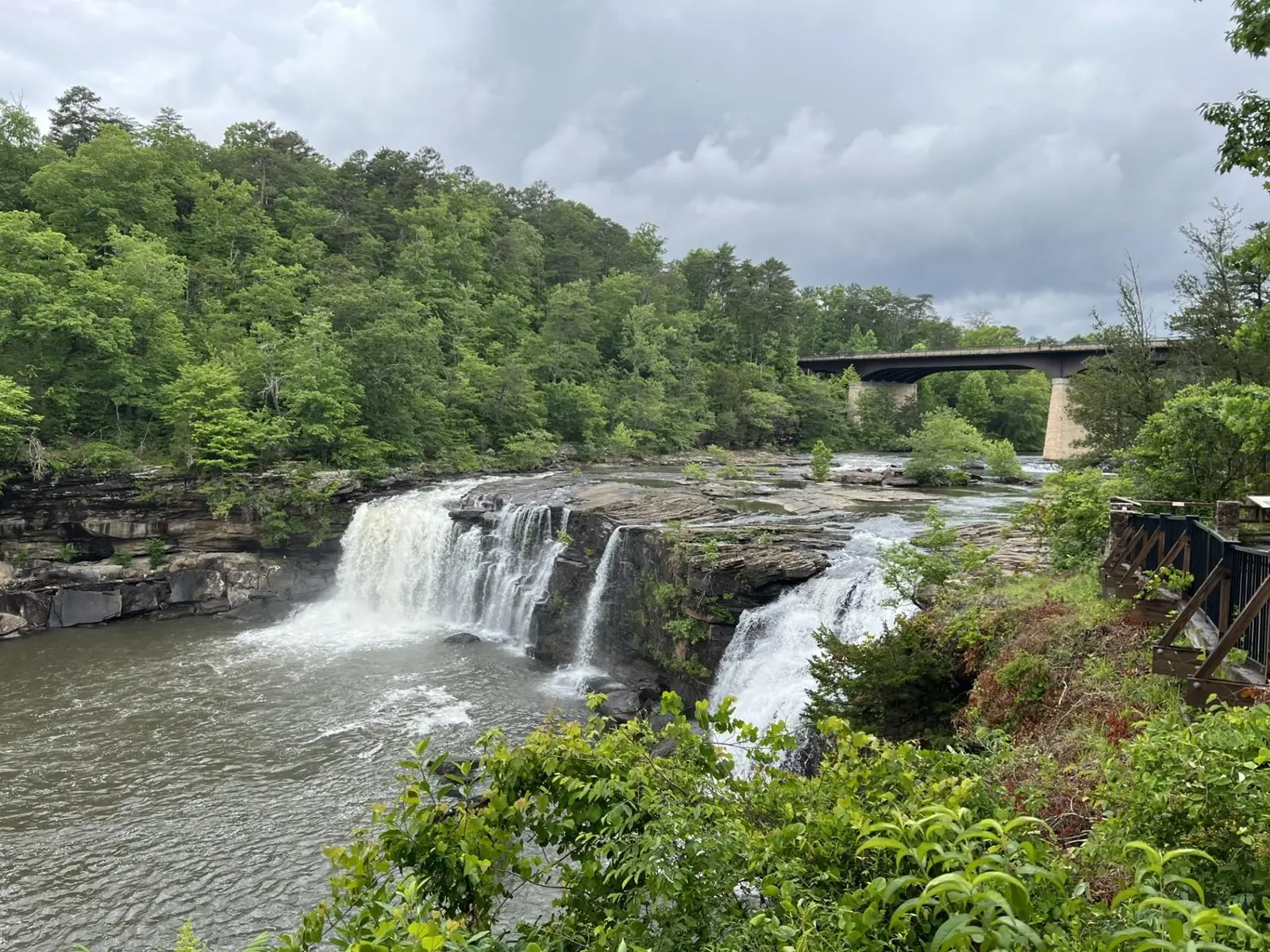
NPS identifies accessible parking and an ADA boardwalk to the main Little River Falls overlook. The Canyon Center is wheelchair accessible and its film includes captions. NPS also states plainly that the preserve’s natural hiking trails are not ADA accessible because they can be narrow and contain roots and other tripping hazards.
DeSoto State Park and DeSoto Falls
The main park lists an ADA-accessible boardwalk trail. At the separate DeSoto Falls area, the upper falls and historic dam are described as open to visitors of all abilities, while the main lower overlook involves roughly 50 concrete steps. These are different experiences; confirm the exact route before driving.
Overlooks and the village
Roadside does not always mean level. Parking surfaces, curbs and short grades vary at canyon overlooks. Eberhart Point has facilities near the top and a paved path with a moderate slope, while the canyon descent is rugged. In Mentone, call lodging and restaurants directly about entrances, bathrooms, parking and room layout rather than relying on a generic accessibility icon.
Plan around the real constraint
- Ask about the surface and slope, not only distance.
- Confirm whether the view is reached before steps begin.
- Keep a weather alternative; rain changes traction.
- Call ahead when a restroom, transfer space or step-free entrance is essential.
Build a day around one dependable route
Start with Little River Falls’ developed boardwalk, then choose a meal with a confirmed entrance and restroom. Add the Canyon Center if its current hours fit. This is a complete outing; an additional natural trail is not necessary to make it worthwhile.
| Need | Ask this | Why it matters |
|---|---|---|
| Step-free access | Is there a continuous step-free route from parking to the view and restroom? | Accessible parking alone does not establish the rest of the visit. |
| Limited walking endurance | How far is the usable viewpoint, and are there places to rest? | A short route may still require standing and a return trip. |
| Wheelchair or scooter | What are the width, slope, surface and current obstructions? | A route description cannot establish today’s condition. |
| Hearing or sensory needs | Are captions available, and when is the quieter visit window? | A film or event can have different needs from an outdoor overlook. |
NPS provides an accessibility contact at 256-845-9605. For lodging, ask about bed height, transfer space and bathroom layout rather than accepting a general icon. For a restaurant, ask about the table and restroom route in addition to the front door. A companion can help with logistics but does not remove an unsuitable grade or staircase.
Strollers and mobility equipment need different decisions
A boardwalk may work for both, but an uneven trail that a parent can lift a stroller across may be unsuitable for a wheelchair. Keep these judgments separate. Wet leaves, temporary closures and maintenance can change an otherwise useful route; confirm the critical part of your plan shortly before travel.