The overlooks worth your time
A good overlook sequence reveals the landscape. Stopping at every pull-off turns the canyon into repeated parking.
On this page
Brow Park: the Mentone view
Brow Park looks west over Valley Head, Little Ridge and toward Sand Mountain. It is the village’s natural sunset stop and works best when you are already in Mentone. Arrive with time, respect the neighborhood and do not make a cloudy horizon into an emergency drive.
Canyon View and Wolf Creek
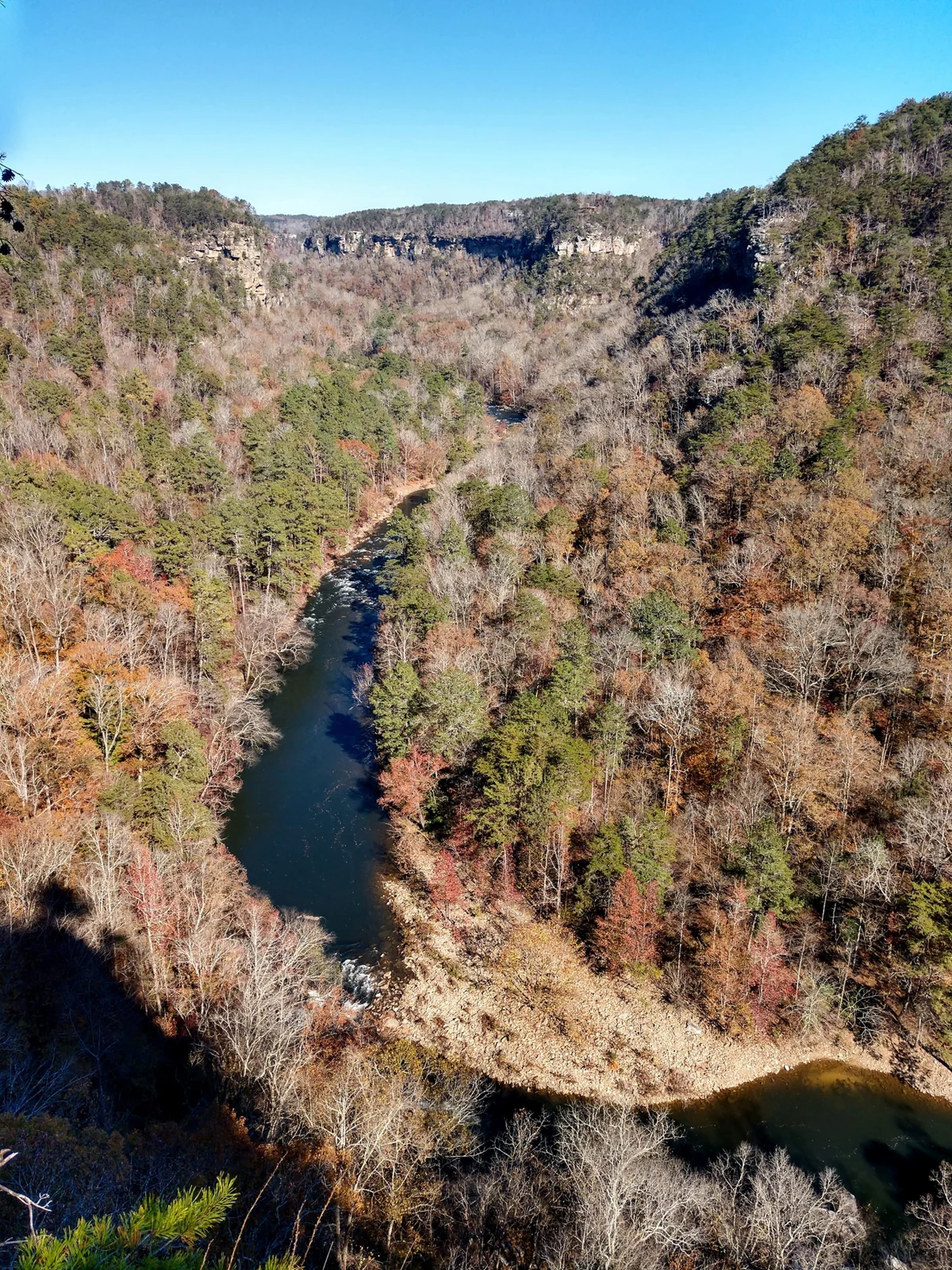
Canyon View delivers an immediate sense of depth and is the logical anchor for a shorter Rim Parkway run. Wolf Creek opens the view farther along the canyon and is better when you want to linger rather than prove you stopped everywhere.
Crow Point and Eberhart Point
Crow Point offers solitude and a view toward the Bear Creek confluence, but its roughly 100-yard path has a curved, semi-steep slope. Eberhart is the last improved overlook, with restrooms and picnic facilities near the top; its paved overlook path has a moderate slope. The dirt descent is a separate, strenuous decision.
Grace’s High Falls is conditional
The overlook remains; the waterfall may not. Grace’s is seasonal and strongest after meaningful rain. Treat it as a canyon view with a possible waterfall, not a guaranteed attraction.
Choose a view for the day you have
| Time and conditions | Choose | Leave out |
|---|---|---|
| Brief village pause | Brow Park when access and visibility suit | A separate canyon circuit |
| Clear canyon morning | Two or three established rim stops | An obligation to stop at every turnout |
| Fog or hard rain | An indoor cultural stop or cabin time | Driving between overlooks hoping distance will fix visibility |
| Limited walking | A confirmed developed viewing route | A descent chosen because it looks short |
Look at the landscape instead of repeating the photograph
Give one view several minutes. Notice the river’s position, the sandstone walls and how sunlight changes the shape of the valley. With children, ask them to trace where water has cut the rock rather than making each stop another posed photograph. Keep the activity behind barriers and away from unprotected edges.
Canyon overlooks operate in daylight; do not import a village sunset plan into a park that closes at dusk. Put the final canyon stop early enough for the return. For photography, use established parking and viewpoints rather than stopping on a narrow road or stepping beyond a barrier for a better angle.